ヒトの柔らかさ知覚の研究をarXivにアップロードしました。
Heterogeneous Layered Structures Can Modulate Human Softness Perception
Yuno Higuchi, Yosuke Iwashita, Yuji Ohgi, Masashi Nakatani
https://arxiv.org/abs/2604.20092
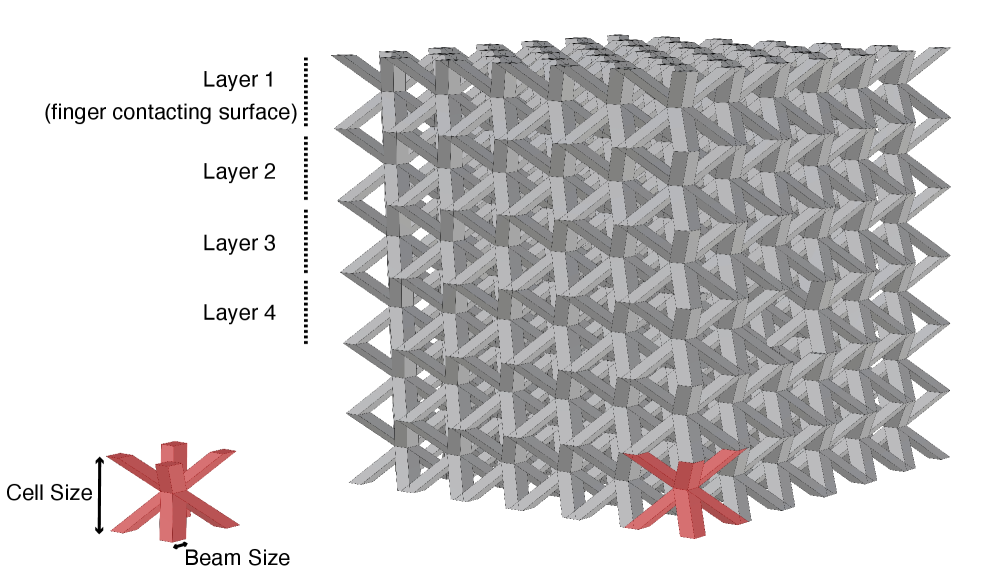
Human softness perception in haptics has mainly been studied using mechanically homogeneous objects, despite the fact that many real-world objects exhibit heterogeneous layered structures with nonuniform stiffness. This study examined how layered heterogeneity modulates haptic softness perception. Sixteen lattice-structured stimuli were fabricated by 3D printing, with the stiffness of the upper four layers systematically varied while the bottom two layers remained fixed. Twenty-two participants evaluated the softness of the stimuli in a psychophysical task, and compression tests were conducted to quantify their mechanical properties. Perceived softness was significantly predicted by displacement under load, however, perceptual ranking did not fully coincide with the physical ranking. Linear mixed-effects analyses showed that the softness of the outermost layer had the greatest impact on the perceived softness. Perceived softness also increased as the number of soft subsurface layers increased, although this contribution decreased with depth. Layers 2 and 3 showed significant effects, whereas Layer 4 did not. These findings suggest that haptic softness perception depends not only on the overall stiffness but also on the depth-dependent distribution of compliance within layered structures.
ハプティクスにおける人間の柔らかさ知覚は、これまで主に、機械的に均質な対象物を用いて研究されてきた。しかし、実世界の多くの対象物は、剛性が一様ではない不均一な層状構造を有している。本研究では、このような層状の不均一性が、触覚による柔らかさ知覚をどのように変調するのかを検討した。
本研究では、3Dプリントにより16種類の格子構造刺激を作製した。これらの刺激では、上部4層の剛性を系統的に変化させる一方で、下部2層は固定した。22名の参加者が心理物理実験において各刺激の柔らかさを評価し、さらに圧縮試験を行うことで、それぞれの機械的特性を定量化した。その結果、知覚された柔らかさは、荷重下での変位量によって有意に予測された。しかし、知覚上の順位は、物理的特性に基づく順位と完全には一致しなかった。線形混合効果モデルによる分析の結果、最外層の柔らかさが、知覚された柔らかさに最も大きな影響を与えることが示された。また、柔らかい下層の数が増えるほど知覚される柔らかさは増加したが、その寄与は深さとともに減少した。第2層および第3層は有意な効果を示した一方で、第4層の効果は有意ではなかった。
これらの知見は、触覚による柔らかさ知覚が、対象物全体の剛性だけでなく、層状構造内部におけるコンプライアンスの深さ依存的な分布にも依存することを示唆している。